

Balance. Seeing 1616 can feel reassuring when you’re trying to care for people you love and make progress on something of your own. In angel-number practice, the repeated 16 can be an invitation to decide what balance would look like in your particular week.
Read 1616 as 1, 6 and 5
In many numerology interpretations, 1 stands for initiative and 6 for home, care and responsibility. The pair repeats in 1616. Adding 1 + 6 + 1 + 6 gives 14, which reduces to 5. If you associate 5 with flexibility, it can prompt you to ask which arrangement could change so both care and independence have room.
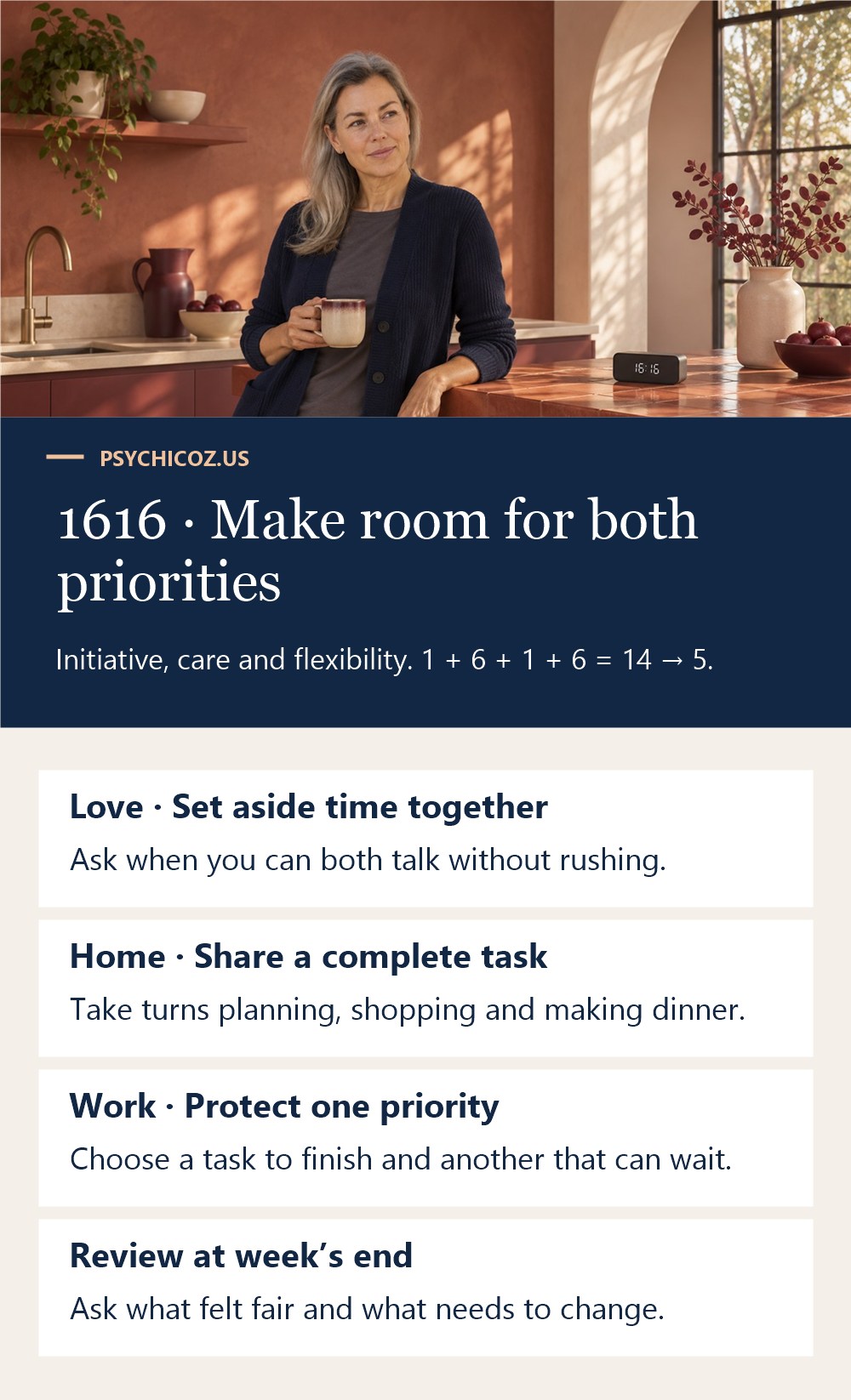
Read the infographic as text
1616 brings together initiative, care and flexibility. Add 1 + 6 + 1 + 6 to get 14, then add 1 + 4 to get 5.
- Love. Set aside time together. Ask when you can both talk without rushing.
- Home. Share a complete task. Take turns planning, shopping and making dinner.
- Work. Protect time for one priority. Choose a task to finish and another that can wait.
At week’s end, ask what felt fair and what needs to change.
At home, ask for one specific change
Imagine noticing 16:16 as you finish another long day and realize you’re still the person planning every meal. You could use the moment to ask for a concrete adjustment. “Could you plan and handle Wednesday dinners this month?” gives both people something they can discuss and revisit.
In love, leave room for two voices
For someone dating, 1616 can invite a conversation about what makes each person feel at home. Ask about time together, time alone and how you handle a change of plans. If you’re already together, consider which commitments feel fair to both of you and what each person has actually agreed to.
At work, define enough for this week
If you’re aiming for a change at work, identify one step that fits your current capacity. You might set aside time to update a portfolio or ask what a promotion would involve. Give the step a place on your calendar alongside your existing commitments. If they clash, decide what you can move or ask someone to share.
Give both priorities a place in the week
Suppose a training course meets on the evening you normally handle a family commitment. The two 1s can prompt you to name one goal each person wants to protect. The two 6s can remind you to count the work that keeps the household running. Write down the time for the course, the work that needs coverage and who has agreed to do it. Include preparation and follow-up, such as arranging a ride or notifying someone if the plan changes.
Try the arrangement for two weeks. At the end, ask whether each person got the time they agreed to and who had to chase reminders or step in at the last minute. If one person still carried most of the planning, move ownership of a whole task or change the schedule together.

When you want more time together and more time alone
Imagine enjoying someone’s company while feeling worn out by three weeknight dates in a row. You can say, “I’d like to see you this weekend, and I’m keeping Thursday to myself. Would Sunday work for you?” Give them room to suggest a different day. Notice whether both of you can ask for time, accept a change and keep the plans you make together.
A quiet way to work with the number
If you pray or speak with angel guides, you might ask for clarity about one responsibility that feels heavy. Then pick a response available to you today, such as requesting help or naming a time you’ll be free. When the number appears again, you can return to the same question or let the moment pass.
What a fairer week could look like
If 16:16 catches your eye in a busy week, give the themes of initiative and care one action each.
- 1 · Make a request. “I’d like Saturday morning for a walk. Can we talk about when to do the weekly shopping?”
- 6 · Ask what would help. “What time would you like to keep for yourself this weekend?”