
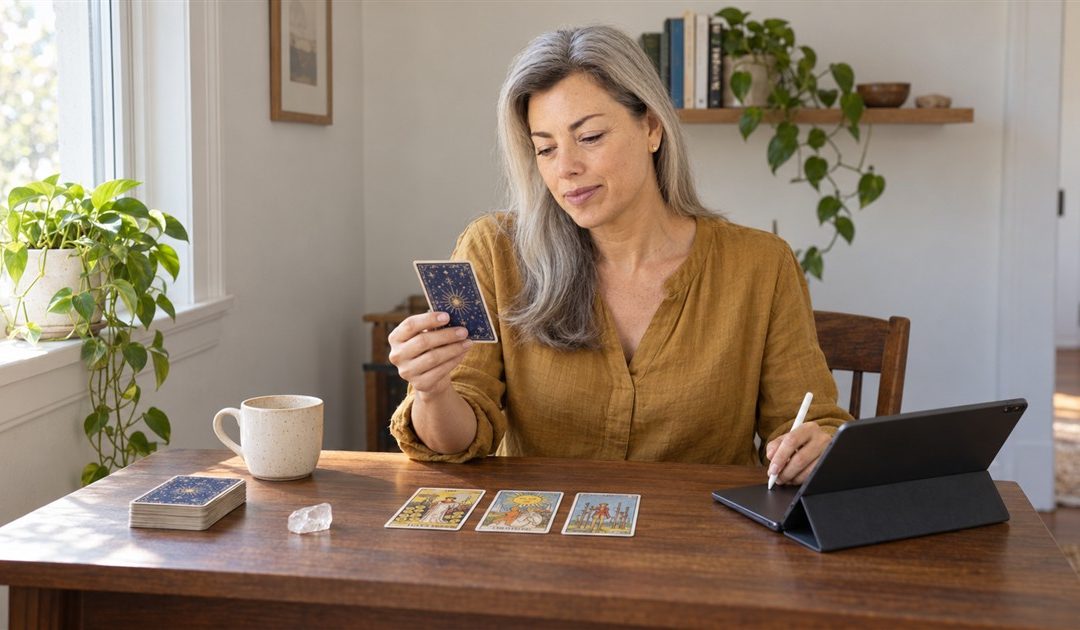
One tarot card can give you an image to think with: a lantern, an open path, a person carrying too much. You may approach the deck as a spiritual practice, an intuitive conversation or a creative prompt. For self-development, the useful movement is from noticing an image to naming a question and choosing an action.
You do not need an elaborate weekly ritual or a prediction about your future. A brief session that leaves you clearer about one present concern can be enough.
What is in a tarot deck?
Many familiar decks contain 78 cards: 22 Major Arcana and 56 Minor Arcana. The Minor Arcana usually has four suits, often called Cups, Wands, Swords and Pentacles, with names and artwork varying by deck. Major cards can be read through broad life themes; minor cards often invite attention to everyday experiences.
Tarot began as a card game in fifteenth-century Italy. Occult and divinatory uses developed later, including in the late eighteenth century. The Morgan Library’s tarot collection overview and discussion of occult tarot provide historical context. Modern spiritual practice is one way people use this evolving imagery.
Read the symbol as a question
The Hermit: a lantern
Question: What would help me think more clearly?
Action: Make a short quiet pause before replying to a difficult message.
Ace of Pentacles: a new resource
Question: Which practical opportunity is worth investigating?
Action: Check the requirements, cost and next step before committing.
The Tower: disruption
Question: Which assumption deserves a fresh look?
Action: Review one plan using current facts. The image does not predict a disaster.
Five of Pentacles: difficulty and support
Question: Where could I ask for practical help?
Action: Identify a suitable person or service. A card does not diagnose hardship or reveal a financial future.
These examples use motifs common in Rider–Waite–Smith-style decks. Your card may look different. A guidebook can offer context, while your association remains something to examine rather than an unquestionable hidden truth.
A simple one-card self-development practice
- Choose a present topic: “How do I want to approach this conversation?” is more useful than trying to expose someone else’s private thoughts.
- Draw one card: Notice the artwork before looking up a meaning.
- Describe: Name two or three visible details without turning them into a prediction.
- Associate: What feeling, value or question comes to mind?
- Check: What actual information supports or challenges the association?
- Choose: Take one small action within your control.
You may keep a private note on a phone, tablet or paper. Include what did not fit as well as what did. Later, look for changes in your choices rather than counting only apparent “hits.” Repeatedly drawing until you get reassurance can make a session less useful.
A three-card spread for a decision
1. My present view
What part of the situation am I paying attention to? What might I be overlooking?
2. A difficulty to consider
What obstacle or trade-off deserves checking? Do I have facts for it, or only an image?
3. A possible response
What action could I choose, and what practical information or advice do I need first?
Worked example: You are considering a new role. The Hermit prompts a pause to clarify priorities, Two of Pentacles prompts a question about workload, and Page of Pentacles prompts research into training. The next step is to ask about hours and costs. The cards do not decide whether you should resign or guarantee success.
When a card feels frightening
Death, the Tower and Ten of Swords can evoke a strong reaction. You can put the deck down, take a break or ask a gentler question. A dramatic image does not establish that someone will die, disaster is coming or you must make an urgent change.
Try asking, “What is one concern I can address using facts?” You may also decide the card is not useful today. No reader should use frightening imagery to demand money for protection or curse removal.
Intuition, energy language and personal choice
Some people describe receptive attention, care or intuition as feminine energy. You may use that metaphor if it fits, but these human capacities belong to people of every gender. Tarot does not require a particular identity, belief or energy role.
You can regard a session as sacred time without insisting that every impression comes from a guide. The cards may feel like a familiar companion, but keep room for actual friends, community and appropriate professional care. Tarot is not a substitute for mental-health treatment or a way to recover verified hidden memories.
Choose a manageable setup
Use a deck whose images you can see comfortably and a guidebook you can understand. Rider–Waite–Smith imagery has many learning resources, but another deck may fit you better. Start with one card or three rather than a large spread you feel obliged to decode.
You can sit in ordinary light without smoke, a candle or special purchases. If you try quiet contemplation, let it be optional and stop if it increases distress. There is no required daily streak or 45-minute session.
Free image-to-action tarot log
- My question: a present concern within my own life.
- What I see: card name and two visible details.
- My association: a possible feeling or theme.
- What I know: facts, alternatives and missing information.
- My action: one proportionate step I choose.
- Later review: what helped, what did not fit and what I learned.
Example: “Conversation with a friend → Hermit, lantern and quiet figure → I need thinking time → I do not yet know their view → ask to talk tomorrow, then listen.”
Let reflection return to your life
For more card symbolism, see the Major Arcana meanings guide. If you prefer a familiar pack, our playing-card reflection guide offers another approach.
A useful reading leaves you able to ask a clearer question, gather information or make a choice. You can keep spiritual meaning in the practice while letting your life remain larger than the cards.
Frequently asked questions
1. Can I use tarot for self-development?
You can use its images as prompts for reflection and action, without treating a card as a guaranteed prediction.
2. Do I need psychic abilities?
No. You can begin by describing the artwork and asking what it brings to mind.
3. How many cards are in a common tarot deck?
Many decks have 78 cards: 22 Major Arcana and 56 Minor Arcana. Other designs may vary.
4. Did tarot begin as fortune-telling?
It began as a card game in fifteenth-century Italy; occult and divinatory uses developed later.
5. What is a good first question?
Choose a present concern within your own life, such as how you want to approach a conversation.
6. Must I draw a card every day?
No. Choose a frequency that helps, and pause when the practice feels unhelpful or compulsive.
7. Should I keep drawing until I feel reassured?
Repeated reassurance-seeking can make the practice less useful. Consider ending the session and returning to current facts.
8. What if the interpretation does not fit?
Record that too. You do not have to force every image into your life.
9. Does the Death card predict death?
A card does not establish that someone will die or that a feared event will occur.
10. What can I do with a frightening card?
Pause, put the deck down or ask a gentler question. Do not make an urgent decision because of the image.
11. Can cards reveal someone’s private thoughts?
An interpretation does not establish another person’s feelings, consent or hidden actions.
12. Is feminine energy required?
No. Receptivity, intuition and care are human capacities, and no gender or energy role is required.
13. Can tarot replace therapy?
No. Seek qualified care for mental-health concerns. A personal reflection practice can remain separate.
14. Do I need candles or special tools?
No. Ordinary light, a deck and an optional place to record a thought are enough.
15. How do I use the free log?
Separate your question, visible details, association, known facts and chosen action, then review what helped and what did not.