
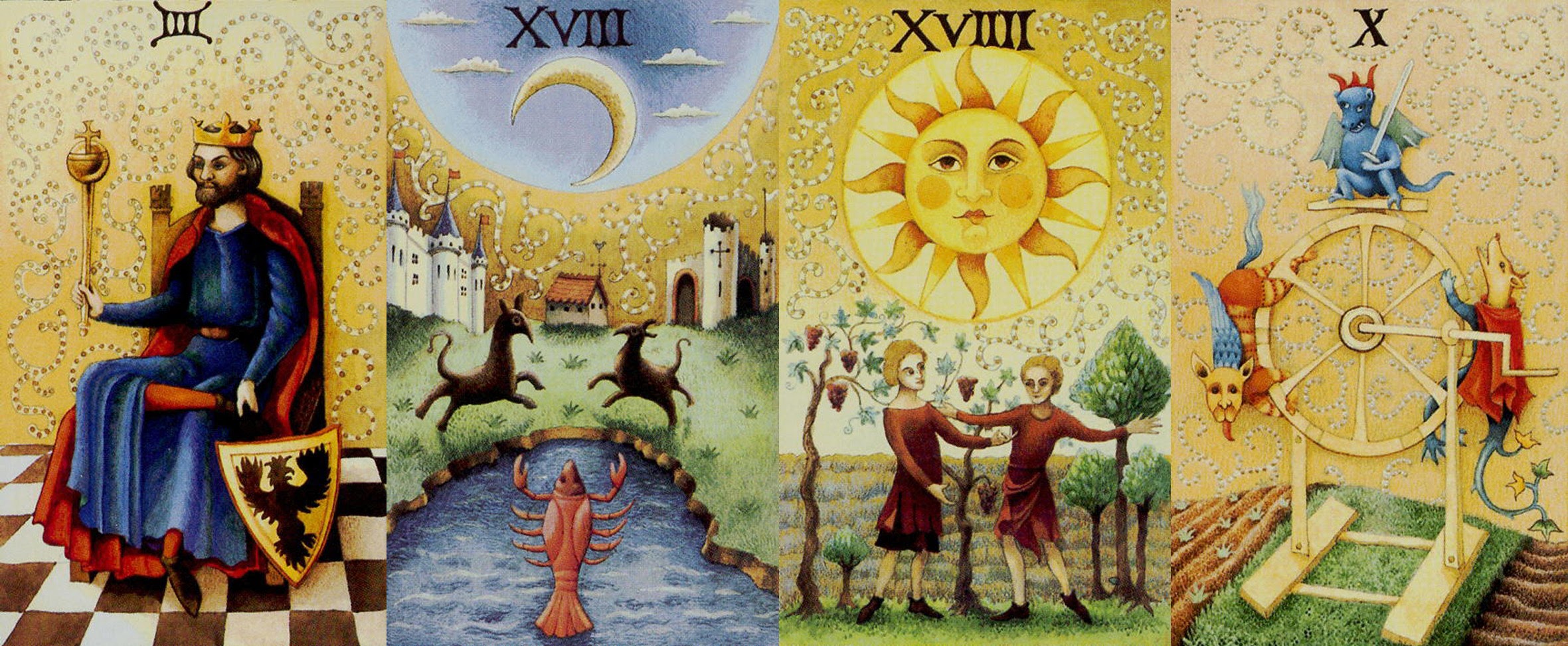
The Major Arcana are the 22 illustrated trump cards in a standard 78-card tarot deck. Readers often use them to explore broad themes—change, choice, authority, uncertainty, loss, hope, and completion. Their meanings are traditions and interpretations, not fixed predictions or messages proven to come from a spirit world.
Tarot began as a card game, not an occult system. The Metropolitan Museum of Art’s history of early tarot traces Italian examples to the 1400s and notes that fortune-telling associations became prominent much later. The British Museum also catalogs historical tarot cards as material objects and playing cards.
How to Read Major Arcana Meanings
Use each card as a prompt, not a verdict. First describe the image, then select a theme that fits the question, identify evidence from real life, and choose a safe action. Deck artwork, traditions, and readers differ, so no keyword is universal.
A reversed card does not automatically mean disaster. Some readers interpret reversal as delay, excess, avoidance, an internal process, or simply a different angle. You may also read every card upright.
Major Arcana 0–5: Beginnings, Agency, and Structure
0 — The Fool
Common themes: beginning, openness, risk, curiosity. Reflection: What can I explore while keeping enough information, time, and protection?
1 — The Magician
Common themes: skill, initiative, communication, resources. Reflection: Which tool or ability can I use now, and what limitation must I acknowledge?
2 — The High Priestess
Common themes: reflection, privacy, intuition, uncertainty. Reflection: What deserves quiet attention, and which assumption still needs verification?
3 — The Empress
Common themes: care, creativity, abundance, embodiment. Reflection: What can I nurture without stereotyping femininity or neglecting my own boundaries?
4 — The Emperor
Common themes: structure, authority, planning, limits. Reflection: Where would a clear rule help, and where could control become rigid or coercive?
5 — The Hierophant
Common themes: tradition, teaching, institutions, shared values. Reflection: Which tradition supports me, and which rule deserves respectful questioning?
Major Arcana 6–10: Choice, Movement, and Cycles
6 — The Lovers
Common themes: relationship, alignment, values, choice. Reflection: Do words, consent, behavior, and shared expectations align?
7 — The Chariot
Common themes: direction, determination, coordination, momentum. Reflection: What goal am I steering toward, and what pace remains safe?
8 — Strength
Common themes: courage, patience, self-regulation, compassion. Reflection: What would steady strength look like without suppressing emotion or dominating someone?
9 — The Hermit
Common themes: solitude, study, inner review, guidance. Reflection: Would time alone clarify this, or am I becoming isolated from useful support?
10 — Wheel of Fortune
Common themes: cycles, probability, change, limited control. Reflection: What is outside my control, and which response still belongs to me?
Major Arcana 11–15: Accountability, Perspective, and Attachment
11 — Justice
Common themes: fairness, evidence, responsibility, consequences. Reflection: What facts, rights, obligations, and affected people must be considered? Tarot is not legal advice.
12 — The Hanged Man
Common themes: pause, new perspective, release, waiting. Reflection: Would a pause create insight, or is delay increasing risk or avoiding action?
13 — Death
Common themes: ending, transition, grief, renewal. Reflection: What is ending, what deserves grieving, and what should not be rushed? This card does not predict physical death.
14 — Temperance
Common themes: moderation, integration, adjustment, patience. Reflection: Which competing needs can be combined, and what practical limit would restore balance?
15 — The Devil
Common themes: attachment, compulsion, shame, power. Reflection: What pattern narrows my choices, and what support could expand them? Sexuality itself is not immoral.
Major Arcana 16–21: Disruption, Hope, and Integration
16 — The Tower
Common themes: disruption, revelation, unstable structures, shock. Reflection: What actually changed, what is urgent, and what foundation needs qualified help to rebuild?
17 — The Star
Common themes: hope, renewal, generosity, direction. Reflection: What evidence supports hope, and which small action can carry it forward?
18 — The Moon
Common themes: ambiguity, imagination, fear, dreams. Reflection: What is unclear, what alternatives exist, and which facts can I check before acting?
19 — The Sun
Common themes: visibility, vitality, confidence, joy. Reflection: What is going well, and how can I enjoy it without assuming every outcome is guaranteed?
20 — Judgement
Common themes: review, accountability, awakening, decision. Reflection: What have I learned, what repair is possible, and which choice fits my current values?
21 — The World
Common themes: completion, integration, belonging, transition. Reflection: What is complete enough to acknowledge, and what begins next?
A Three-Card Major Arcana Practice
Remove the Major Arcana, shuffle, and draw three cards for:
- Situation: Which theme helps describe what I am noticing?
- Tension: What conflict, limit, or missing information deserves attention?
- Next step: What small, reversible, consent-respecting action can I take?
Write at least one real-world fact beside every interpretation. If you prefer ordinary playing cards, our grounded cartomancy guide explains suits, numbers, and a similar three-card method.
Tarot and High-Stakes Decisions
Do not use a card to diagnose illness, decide whether to stop treatment, identify a criminal, prove infidelity, determine pregnancy, override consent, drive in unsafe conditions, or make a major legal or financial commitment. A card can suggest a question; evidence and qualified professionals must answer consequential questions.
For intuition that feels especially compelling, use the stakes-and-reversibility check in learning to trust intuition safely.
Choosing a Responsible Tarot Reader
A responsible reader explains that interpretations are not guarantees, protects privacy, obtains consent before reading about sensitive topics, and accepts “no.” Leave if someone claims a curse, predicts unavoidable harm, demands secrecy, or requires repeated payments to fix a card. The FTC warns that gift-card payment demands are a scam sign.
Frequently Asked Questions
How many Major Arcana cards are in tarot?
A standard tarot deck has 22 Major Arcana cards: The Fool numbered 0 and 21 numbered trump cards ending with The World.
Does drawing Death predict physical death?
No. Tarot cannot reliably predict death. Readers commonly use the card as a symbol of endings, transition, grief, or change.
Are reversed Major Arcana cards bad?
Not automatically. Reversal may be read as delay, excess, avoidance, internal focus, or another angle. Some readers do not use reversals at all.
Can Major Arcana cards make decisions for me?
No. Use them as reflection prompts. Keep agency, verify facts, respect consent, and use qualified help for health, safety, legal, financial, or mental-health decisions.