
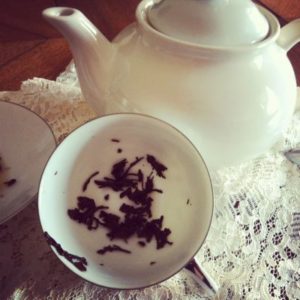
Tasseography is the practice of interpreting patterns left by tea leaves, coffee grounds, or wine sediment. Today it is commonly used as divination, storytelling, or a reflective ritual. The shapes do not objectively predict love, money, health, danger, or fate, but they can prompt associations and questions in much the same way as an ambiguous picture or creative-writing exercise.
The history is more complicated than a single secret tradition passed unchanged through medieval women. Tea did not become widely established in Britain until the seventeenth and eighteenth centuries. Surviving objects and images show that tea-leaf reading was familiar by the nineteenth century and later became a popular domestic form of fortune-telling. A Smithsonian collection record, for example, describes an English daguerreotype from the 1840s or 1850s showing sisters reading tea leaves.
What you need
- A light-colored cup with a plain interior and a handle;
- Loose-leaf tea large enough to see clearly;
- Hot water prepared safely;
- A saucer or small plate;
- Paper and a pen for recording the pattern before interpreting it.
A traditional cup is optional. The Museum of Witchcraft and Magic documents a purpose-made fortune-telling cup from the 1930s or 1940s, illustrating how printed symbols were sold to support the practice.
A seven-step tea-leaf reading
1. Choose a low-stakes question
Use a reflective prompt such as “What deserves my attention this week?” Avoid asking the cup to diagnose illness, identify a criminal, locate a missing person, prove infidelity, or decide a legal or financial matter.
2. Brew and drink safely
Follow the tea’s preparation instructions, protect against hot-water burns, and check ingredients for allergies, pregnancy considerations, medication interactions, or other medical restrictions. Herbal products are not automatically safe for everyone. If caffeine matters to you, review the FDA overview of caffeine and choose an appropriate drink.
3. Leave a small amount of liquid
When only a sip remains, hold the cup by its handle and gently rotate it. There is no scientifically correct number of turns or required direction. Use a consistent method if you want to compare sessions.
4. Drain the cup
Turn the cup onto a saucer briefly, away from electronics and anything that could be stained. Return it upright and let the leaves settle.
5. Record before interpreting
Photograph or sketch the cup. Note where a shape appears, which direction it faces, and your first neutral description: “curved line near handle,” not “journey will happen.” Recording first helps prevent the meaning from changing after an event.
6. List several associations
A shape may resemble a boat, leaf, bird, letter, road, or nothing recognizable. Write at least three possible associations, including ordinary personal memories. There is no universal symbol dictionary that guarantees one meaning.
7. Choose one reversible action
Turn the reading into a question or small step. A “bridge” might prompt you to repair communication; a “key” might prompt you to gather missing information. Do not treat the shape as a command.
How readers use the cup
Many modern systems treat the handle as the reader or present situation. Leaves near the rim may represent what feels immediate, the middle a developing concern, and the bottom something distant, deep, or unclear. Other traditions use different maps. State your chosen system before interpreting rather than changing it to fit the result.
Direction can also be used symbolically: a figure facing the handle may suggest approach, while one facing away may suggest departure. Reversed images do not automatically turn “success” into “failure.” Rotation changes orientation easily, and ambiguous marks invite multiple readings.
A flexible symbol guide
- Anchor: stability, attachment, or feeling stuck;
- Bird: news, movement, freedom, or distraction;
- Boat: travel, transition, distance, or shelter;
- Circle: completion, repetition, inclusion, or a boundary;
- Cloud: uncertainty, worry, weather, or imagination;
- Dog: loyalty, companionship, responsibility, or protection;
- Eye: attention, observation, privacy, or feeling watched;
- Gate: access, opportunity, permission, or an obstacle;
- Heart: affection, grief, desire, care, or vulnerability;
- Mountain: challenge, distance, ambition, or perspective;
- Tree: growth, family, roots, seasons, or patience;
- Question mark: uncertainty, curiosity, or missing information.
The word “or” matters. Symbols are prompts, not fixed predictions. Personal and cultural associations may differ, and a threatening-looking shape is not evidence of danger.
A three-column interpretation method
Divide a page into observation, possible meaning, and safe action. For example: “two crossing lines”; “conflict, crossroads, or simple overlap”; “ask what choice actually needs attention.” This keeps imagery separate from conclusions.
For another symbolic system with defined suits and numbers, see the grounded cartomancy guide using playing cards. To test first impressions without treating them as proof, use the seven-part intuition calibration method.
Ethics and safety
Ask permission before reading for someone else. Do not make claims about a third person’s thoughts, fidelity, pregnancy, health, guilt, or future. Never use a symbol to frighten someone into paying for cleansing, protection, or repeated readings.
Record misses as carefully as striking matches. A shape may feel personally meaningful while still reflecting chance, expectation, memory, or pattern recognition. For high-stakes choices, use evidence and qualified professional guidance.
Frequently Asked Questions
Can tea leaves predict the future?
There is no reliable evidence that leaf patterns predict future events. Tasseography can be used as a spiritual, social, or reflective practice without treating it as factual forecasting.
Do I need a special tasseography cup?
No. A light-colored cup with a plain interior makes patterns easier to see. Printed symbol cups are historical and modern aids, not requirements.
What if I cannot see a recognizable shape?
Record lines, clusters, empty areas, and location without forcing an image. “No clear shape” is a valid result and does not indicate weak intuition.
Does an upside-down symbol mean the opposite?
Not necessarily. Orientation changes easily, and traditions differ. Choose a method in advance and treat any meaning as one possible prompt rather than a prediction.